
A laundry has four stages: sorting, washing, drying, finishing. Capacity is not the sum of the machines — it is the throughput of the slowest stage, measured in kilos per hour, every hour of the shift.
This guide covers the planning sequence we use for on-premises laundry rooms and commercial laundries.
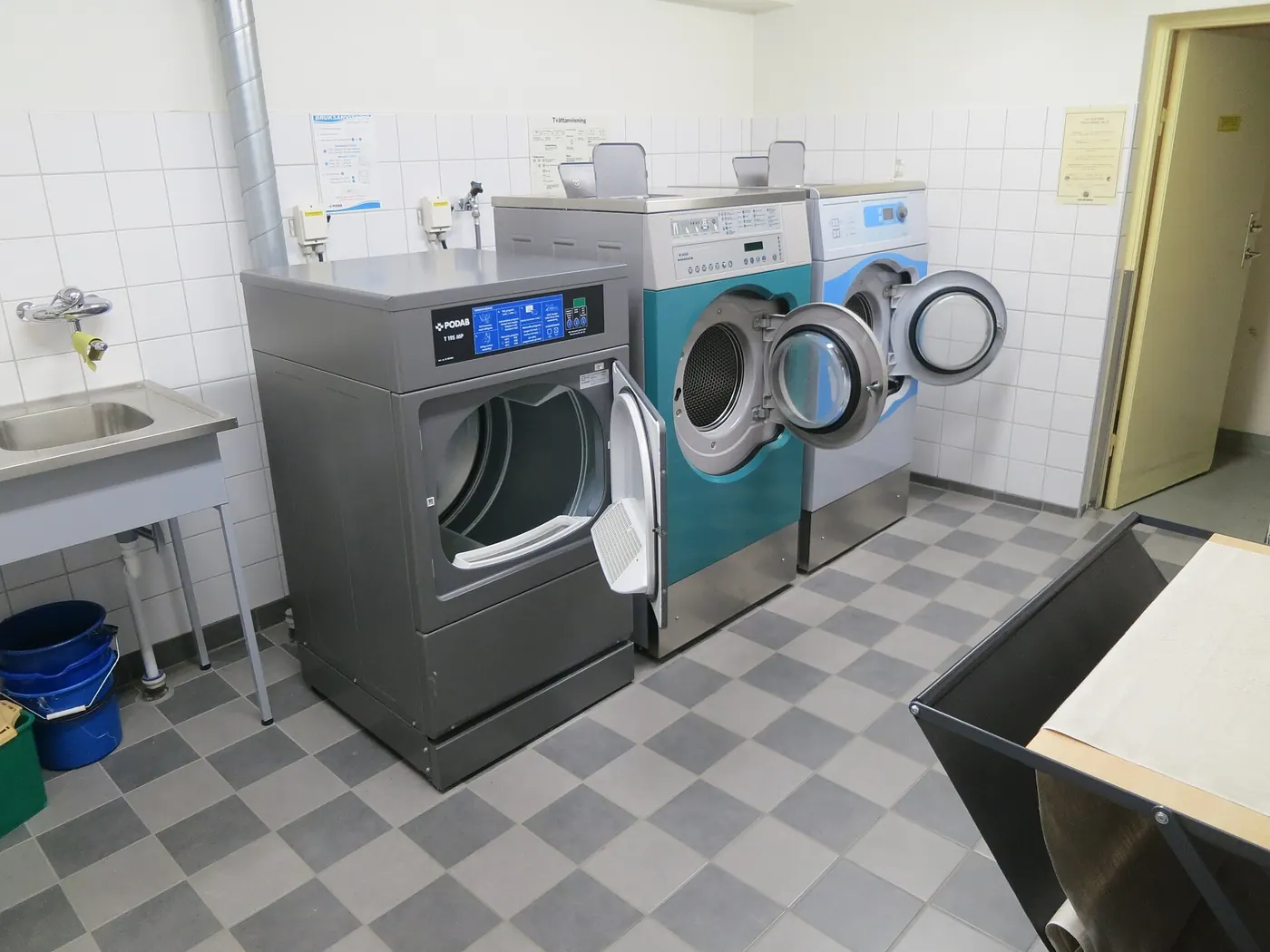
1. Calculate the real workload
Work from linen weights, not from room counts. A practical method:
- List linen types: bed linen, towelling, table linen, uniforms, workwear.
- Weigh a representative set of each — an actual duvet cover, an actual towel set.
- Multiply by the number of changes per day, and add a realistic allowance for soiled linen rejected at sorting and re-washed.
- Adjust for textile behaviour: terry towelling is significantly heavier wet and takes longer to dry than polyester-cotton sheeting.
- Add a 15–20% buffer for peaks — weekends, conference periods, seasonal occupancy.
The result is your kilos per day. Divide by the hours you can realistically run the laundry: staffed hours matter more than calendar days.
2. Match capacity at each stage
| Stage | Planning consideration |
|---|---|
| Washing | Drum capacity per cycle, cycle duration by programme, and realistic loading (do not plan for 100% of nominal capacity on every cycle). |
| Drying | Drying is usually the slowest stage. Size dryers to washer output, not to available floor space, and account for heavier towelling loads. |
| Ironing and folding | Throughput depends on cylinder width, number of rollers, feeding speed and how many operators can work the machine. |
| Sorting and storage | Enough soiled holding to prevent the intake becoming chaos at peak, and enough clean storage for a full day's linen. |
Balance the stages and the laundry runs smoothly. Unbalance them and the money spent on the oversized stage buys you nothing but congestion.
3. Design the workflow
Linen should move in one direction with no crossing over. In hygienic applications this is not optional: soiled and clean linen must be physically separated, with barrier washing machines or clearly divided zones and controlled access between them.
- Soiled intake and sorting at one end, close to where linen arrives from the floors
- Washing next, with clear floor space for loading and unloading and for moving trolleys
- Drying adjacent to washing, with ventilation routed away from clean linen
- Finishing and folding on the clean side, with packing and dispatch next to it
- Staff circulation that does not pass soiled linen through the clean area
4. Plan utilities and building requirements
- Water — flow rate and pressure sufficient for simultaneous fills; hardness checked, with treatment if necessary
- Drainage — capacity for the fastest discharge, with lint traps and correct falls
- Electrical supply — three-phase where machines require it, and a distribution board sized for the full bank
- Heating — electric, gas or steam; steam is efficient where a boiler already exists
- Ventilation — extraction for dryers plus make-up air, or the room will run humid and machinery will suffer
- Floor — loading capacity and vibration isolation for hard-mounted washer-extractors
- Access — door widths, corridor turns and lift dimensions for the largest machine
5. Decide new or refurbished, stage by stage
Many successful laundries are built as a mix. New equipment where duty cycles are most punishing and reliability matters most; inspected refurbished machines for stages where a proven unit at a lower capital cost makes the project viable sooner. Whichever route you take, insist on a written condition report, connection data and a clear warranty position — see our guide to buying refurbished equipment.
6. Plan the maintenance before commissioning
Book the maintenance schedule at handover, not after the first breakdown. Lint traps, door gaskets, belts, filters and drainage all have predictable service intervals, and keeping consumables on site turns a two-day stoppage into a two-hour fix.